The 1921 penny value is not about the date alone. This coin can be a low-cost early Wheat cent or a much stronger collector piece. The spread comes from four things: mint, grade, color, and surfaces. That is why one 1921 cent trades for a small amount, while another moves into a far higher tier.
Quick Facts
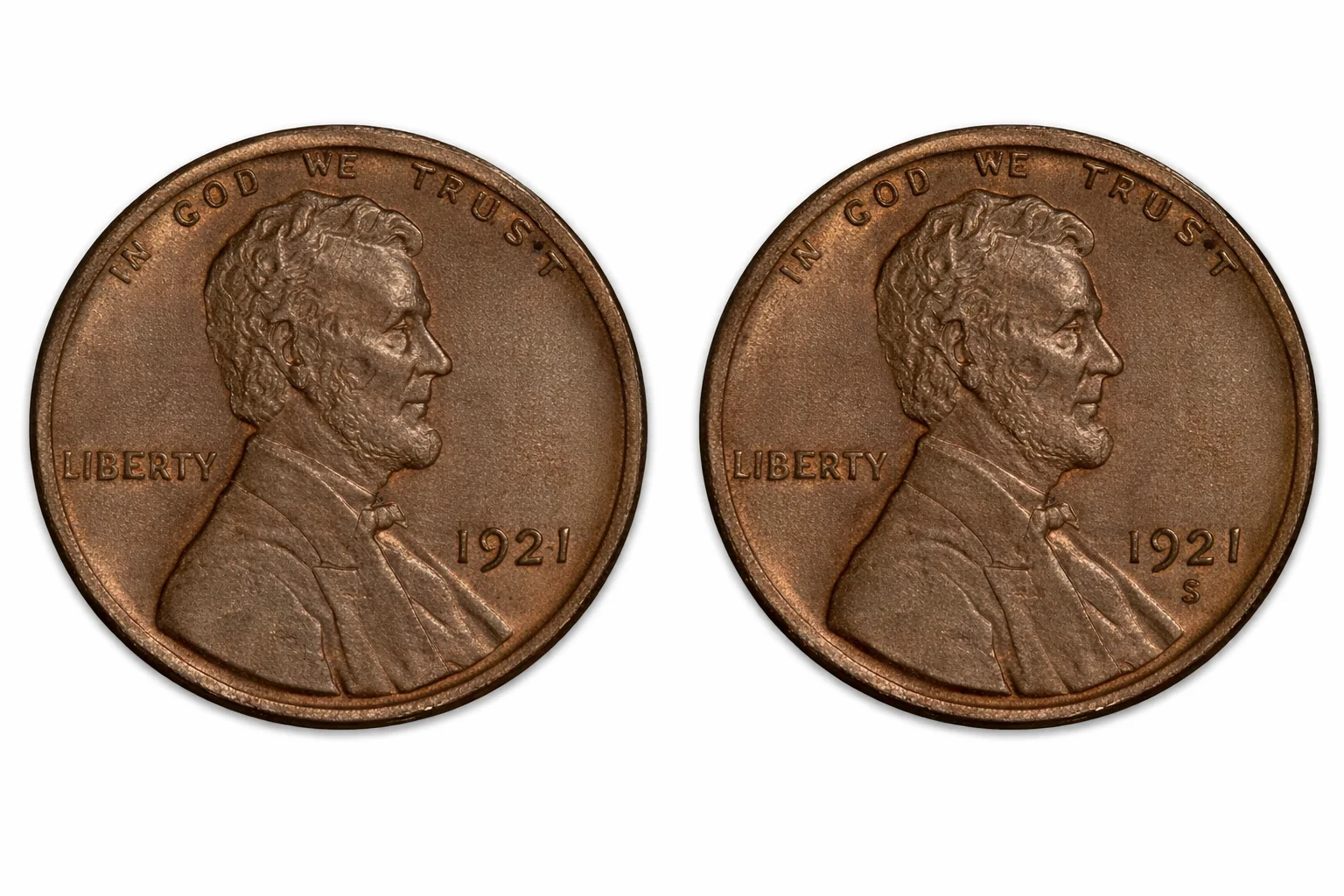
The 1921 penny is a Lincoln Wheat cent. It was designed by Victor D. Brenner. The main parameters you can see in the table below.
| Parameter | 1921 | 1921-S |
| Mint | Philadelphia | San Francisco |
| Mintage | 39,157,000 | 15,274,000 |
| Weight | 3.11 g | 3.11 g |
| Diameter | 19 mm | 19 mm |
| Composition | 95% copper, 5% tin, and zinc | 95% copper, 5% tin, and zinc |
Table note: mintages and specifications from PCGS and NGC.
Two Coins, Not Three
This matters more than many new collectors expect. A lot of Lincoln dates have a three-mint pattern in the mind of the buyer. The 1921 cent does not. You get a plain Philadelphia coin and a San Francisco coin. That is the whole year for regular business strikes. Once you know that, the value structure becomes easier to read. The Philadelphia coin is the easier entry piece. The 1921-S is the one that starts to separate when quality improves.
PCGS survival estimates help explain the split. For 1921 Brown, there are about 3.9 million survivors in all grades, 2,250 in MS60 or better, and 1,000 in MS65 or better. For 1921-S Brown, the estimate drops to 1.5 million in all grades, 1,900 in MS60 or better, and only 160 in MS65 or better. That does not make every 1921-S rare. It shows where the real pressure begins.
Value Nuances
What Changes the Price Most
A 1921 cent is usually priced by a short checklist:
- Mint
- Grade
- Color
- Surface quality
- Eye appeal
- Certification when the coin reaches stronger levels
That is the core logic of this date. Not one factor. Several are working together.
1921 Penny Value By Grade
The first useful split is the Brown value. Brown coins are the baseline market for early Lincoln cents. They are the coins most collectors meet first. They show what the date does before Red-Brown and Red premiums enter the picture.
Brown value chart
| Grade | 1921 BN | 1921-S BN |
| VG-8 | $0.39 | $1.70 |
| F-12 | $0.70 | $3.30 |
| VF-20 | $8 | $5.50 |
| EF-40 | $9.40 | $50 |
| AU-50 | $18.70 | $59 |
| MS-63 | $55 | $198 |
| MS-64 | $66 | $303 |
| MS-65 | $154 | $935 |
Table note: guide values may change. Check relevant data.
The table gives a clear reading. In lower circulated grades, both coins remain reachable. The 1921-S does not explode right away. The stronger break starts near EF and AU, then widens hard in Mint State. That is the pattern collectors need to remember. The date alone does not create the premium. Preservation does.
A second point stands out. Philadelphia is still not a throwaway coin in better grades. Greysheet notes that 1921 Philadelphia pieces are not scarce in circulated condition, but they are among the tougher Philadelphia cents of the 1920s across the board, with MS66 and better very difficult to obtain. That keeps the plain 1921 relevant even if it stays behind the 1921-S at the top end.
Color Changes The Market
Copper is not priced like silver. Color matters. A lot. Lincoln cents are usually grouped as BN, RB, and RD.
- BN means Brown
- RB means Red-Brown
- RD means Red
That simple set of labels changes the market level of the coin. The older the cent, the tougher it becomes to hold strong original red color. On a 1921 issue, that difference is already large. On a 1921-S, it can become dramatic.
High-grade color premiums
| Designation | 1921 MS-63 | 1921 MS-64 | 1921 MS-65 | 1921 MS-66 |
| RB | $66 | $88 | $165 | $440 |
| RD | $110 | $149 | $523 | $1,320 |
| Designation | 1921-S MS-63 | 1921-S MS-64 | 1921-S MS-65 | 1921-S MS-66 |
| RB | $264 | $495 | $1,210 | $7,700 |
| RD | $440 | $1,980 | $11,000 | — |
Table note: Prices may change; double-check the results.
This is where the article stops being about “an old penny” and starts being about market tiers. A 1921 Brown coin is one market. A 1921 Red coin is another. A 1921-S Red coin in strong Mint State is a much smaller and more competitive market again. That is why collectors should never quote one flat number for the 1921 penny value.
Where the Real Premium Begins
The premium usually starts in stages.
1. Circulated range
Most worn 1921 cents are collected as affordable early Wheat cents. They carry interest, but not major upside. The 1921-S is better, yet still not rare in the everyday collector sense.
2. AU to lower Mint State
This is where buyers begin to care more about luster, spots, and surface freshness. A coin may still be obtainable, but the price is no longer driven by date alone. One cleaner piece starts to pull away from another.
3. Gem and better
This is the premium zone. The 1921-S is plentiful through MS64 in Brown and Red-Brown, but extremely difficult to find in MS65 or better in any color. PCGS says the 1921-S Red issue is relatively easy through MS64, then drops off quickly, with none certified by PCGS in MS66 or better in any color format on that CoinFacts listing. That is a sharp signal.
Surface Quality Still Decides The Sale
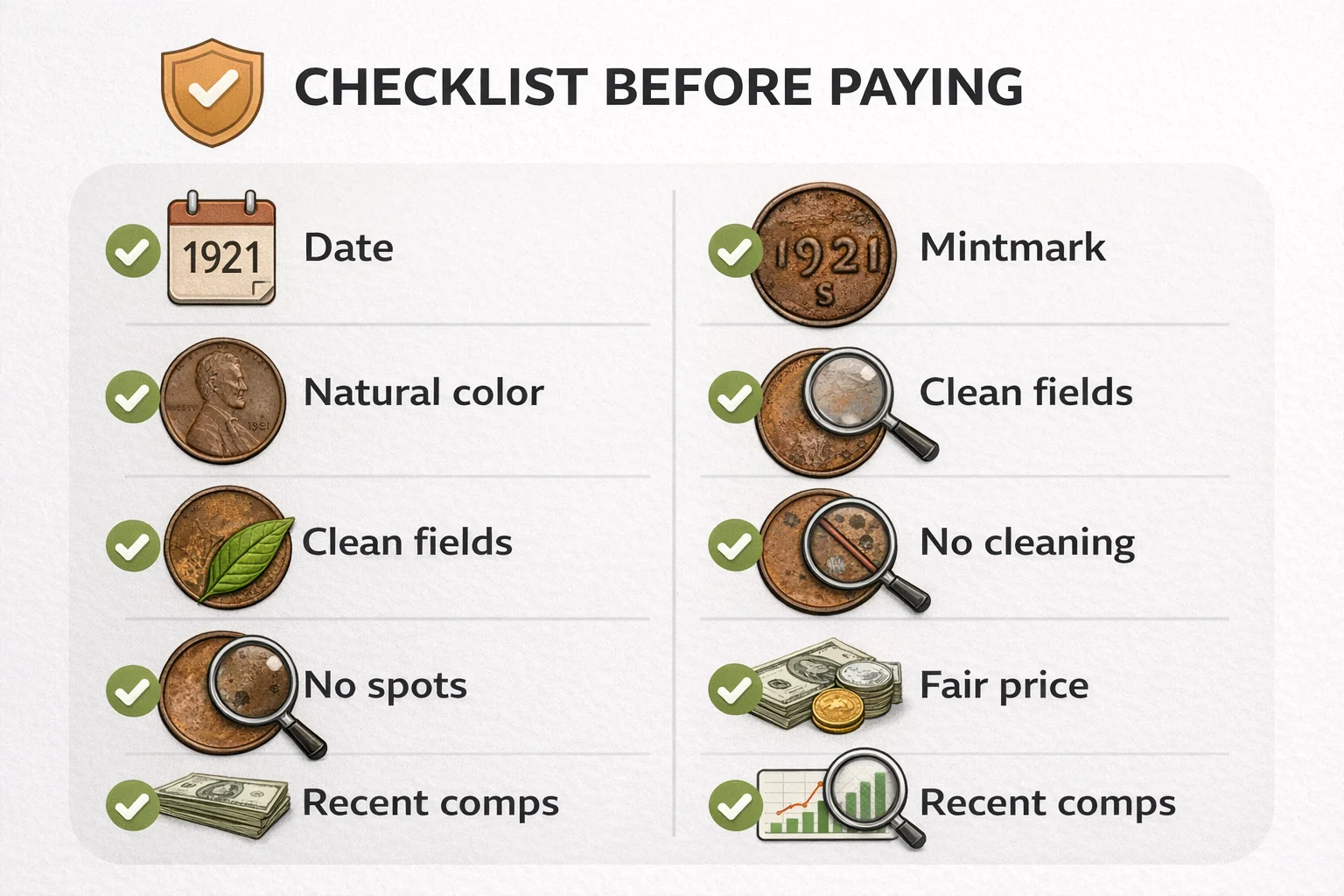
Many buyers focus too hard on the grade and forget the coin in the holder. That is a mistake on copper. Spots, old cleaning, uneven color, carbon, rough fields, and dull luster can all weaken the result. Two coins with the same numeric grade may not trade at the same level if one looks original and the other does not.
Look for these trouble signs:
- Bright but unnatural color
- Hairlines from old wiping
- Dark carbon spots
- Rough or porous texture
- Rim bumps
- Flat, lifeless surfaces
The best coin appraisal app can help with a first-pass review of date, mint, and general category. It cannot replace the close work. A 1921 cent still has to be judged in hand, or from strong images, with real attention to color and surfaces. That is where mistakes happen.
A Small But Useful Nuance on 1921-S
Some 1921-S cents show a weak mintmark. The S on one or more obverse dies was shallowly punched and can be hard to see on worn coins. That means some circulated 1921-S pieces are missed, or mistaken for plain Philadelphia cents, when the buyer checks too quickly. It is a small detail, but a practical one.
1921 vs 1921-S
This comparison keeps the whole date in focus.
| Factor | 1921 | 1921-S |
| Circulated availability | Easier | Still available |
| Lower Mint State | Collectible but moderate | Better premium |
| High-grade pressure | Real | Stronger |
| Color premium | Important | Much stronger |
| Risk of misreading the mintmark | Low | Higher on weak-S pieces |
For most collectors, the plain 1921 is the practical buy. For buyers who want more upside, the 1921-S is the more interesting coin. That does not mean every 1921-S is a winner. It means the ceiling is higher when the coin has the right mix of grade, color, and originality.
Buy, hold, or sell?
A simple working approach helps.
Buy if:
- The coin has original surfaces
- The color is better than average
- The 1921-S is strong for the assigned grade
- The price is fair for the actual look, not just the label
Hold if:
- The coin is solid but not special
- You are building a date-and-mint set
- The piece is attractive enough that replacing it would cost more later
Sell if:
- The coin has problems; the market will punish
- You own a premium 1921-S, and the market is already rewarding the grade
- The coin is certified at a level where registry demand matters more than personal set building
That is the practical side of the 1921 penny value. It is not a mystery date. It is a quality date. The better the coin, the more the market notices.
Conclusion
The main point is simple. 1921 penny value is built on condition first, then color, then mint mark. Philadelphia pieces stay collectible, but the 1921-S carries the stronger premium once quality improves. Brown examples remain the entry tier. Red-Brown and Red pieces move into a different market. The sharpest prices appear when the coin is clean, original, and genuinely scarce for the grade.For a quick first check, the best coin identifier app, such as Coin ID Scanner, can help confirm the date, mint, and even current market price before a closer review. The real value decision still comes from the same old rules: grade, color, surfaces, and a realistic reading of the market.